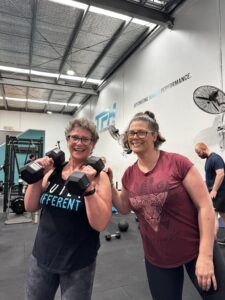
A 65-year-old post-menopausal woman with low bone mineral density picks up a barbell. She deadlifts. Five sets of five at 85% of her one-rep max, twice a week for eight months.
Her lumbar spine bone mineral density increases 2.9%. She moves out of the osteoporotic range.
This is the LIFTMOR trial. 101 post-menopausal women, bone scores already in the danger zone, lifting near-maximal loads. Deadlifts, squats, presses. No injuries. Not one.

The problem isn’t that menopausal women aren’t trying
Most women over 40 who are exercising are doing the right things for the wrong problem.
They’re walking. Going to pilates. Hitting a yoga class a couple of times a week. Maybe a circuit class. Maybe some light weights at home. They’re consistent, they’re showing up, and by every normal measure they’re doing what you’re supposed to do to stay healthy and active.
Nobody told them this wouldn’t work. Not their GP. Not their instructor. Not the class they’ve been attending for three years.
This isn’t a criticism of anyone who’s been doing those things. It’s a criticism of the information — or lack of it — that most women receive about health, exercise and bone health in the first place.
Because here’s what most menopausal women aren’t told: after menopause, bone density loss accelerates sharply. It doesn’t wait. It doesn’t announce itself. You don’t feel it happening. And the activities you thought were serving you well — they are doing essentially nothing for your bones.
Walking won’t cut it. Yoga won’t cut it. Pilates won’t cut it. Circuit classes with light weights won’t cut it. These aren’t bad activities. But they are not a solution to this problem, and the fitness industry has been either too polite or too uninformed to say so clearly.
The load has to be close to maximal. And nothing in that list of activities comes anywhere near the threshold required to actually stimulate bone adaptation.
So if you’ve been exercising for years and your bone scores are low — that’s not your fault. You just weren’t given the full picture.
Why heavy lifting works for menopausal women when everything else doesn’t
Bones respond to strain. It’s called mechanotransduction — the process by which bones detect mechanical stress and respond by laying down new tissue.
The LIFTMOR trial used 80–85% of one-rep max for a reason. Not because the researchers were reckless. Because that’s what the physiology requires. Below that threshold, you’re not creating the stimulus. You’re just moving.
The body doesn’t adapt to what it can already handle. It adapts to demands that exceed what it’s currently capable of. That’s not my opinion. That’s biology.
But here’s where most articles stop. And it’s the wrong place to stop.
It’s one thing to read a study and feel convinced. It’s another thing entirely to walk into a gym having never touched a barbell and feel like you know what you’re doing.
The concerns menopausal women have about starting heavy strength training are completely valid.
What if I hurt myself? What if my technique is wrong? What if my body isn’t ready for this? What if I’ve got an existing condition — a dodgy knee, an old injury, osteoporosis itself — that changes things?
These aren’t excuses. They’re real questions. And they deserve a real answer — not just “trust the science and get under a bar.”
Because here’s the thing. The LIFTMOR trial didn’t just hand participants a program and wish them luck. Every session was supervised. Technique was taught from scratch. Load was built up progressively over a month before anything close to maximal effort was attempted. The coach-to-client ratio was kept deliberately small.
The results didn’t happen despite that support. They happened because of it.
What starting actually looks like
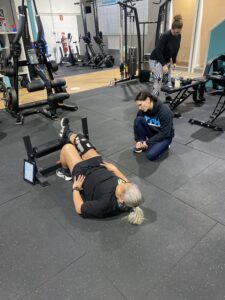
If you’ve never deadlifted before, the first session isn’t about load. It’s about learning how to do a deadlift. What a neutral spine feels like. How to brace. Where your lats are and why they matter.
That takes time. A few sessions, usually. Sometimes more. And that’s fine — because the goal isn’t to lift heavy in week one. The goal is to build the foundation that makes lifting heavy safe, sustainable, and effective six months from now.
A good trainer in this space isn’t just counting reps. They’re watching how you move. They’re adjusting your setup. They’re knowing when to add load and when to hold. They’re the difference between a program that produces results and one that produces a doctor referral.
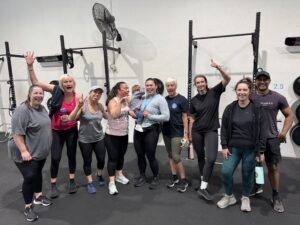
This is what we do at TPH. We work with a lot of women over 40 who come to us having never lifted properly — some with low bone density already, some who just want to get ahead of it. The starting point is always the same: learn the movement, earn the load, trust the process. There’s no rushing it. But there’s also no reason to be afraid of it.
Where to start if you’re not sure
If this is resonating and you’re wondering what your next step looks like, here’s an honest framework:
- Get a DEXA scan if you haven’t had one. Know your numbers. Your GP can refer you, or you can access one privately. It’s the only way to actually track whether what you’re doing is working.
- Find someone who knows what they’re doing. Not every personal trainer has experience programming for bone health, older adults, or people with osteoporosis or osteopenia. Ask the question directly — what’s your experience working with women over 40 on bone density? A good trainer will give you a specific answer.
- Start in a supported environment. A commercial gym floor when you’ve never lifted before is a difficult place to learn. A personal trainer or small group personal training gives you coaching attention and puts you around other people doing the same thing. That matters more than most people expect.
- Don’t wait until it’s urgent. Bone density loss accelerates after menopause. The best time to build the habit is before the numbers become a problem. The second best time is now.
The bottom line
The research is settled. Heavy, progressive strength training builds bone in ways that nothing else does.
Menopausal women who lift properly — with enough load, with good technique, with progressive overload built in — get results that walking and pilates simply cannot produce.
But knowing the research and knowing how to act on it are two different things. The gap between them is where a good coach lives.
If you want to understand what this looks like for you specifically — your history, your numbers, your starting point — come and have a conversation with us. No commitment required. Just an honest chat about where you’re at and what’s actually going to help.
That’s what we’re here for.
– Max Waldron