Most people don’t think about their balance until something happens. A stumble on the stairs. A near-miss getting out of the car. A fall that turns a normal week into months of recovery.
Balance isn’t something you either have or don’t. It’s a skill, and like any skill, it fades without use and improves with practice.
The good news is it responds to training at any age. You don’t need to wait for a scare to start working on it.
What balance actually is
Balance relies on three systems working together:
- Vision, which tells your brain where objects and surfaces are around you
- Your inner ear (the vestibular system), which senses movement and head position
- Proprioception, the sense in your muscles and joints that tells your brain where your body is in space, without you having to look
As we age, all three get a little less sharp. At the same time, strength and reaction speed decline, which means it takes longer to catch yourself when something goes wrong. None of this happens overnight. It’s gradual, which is exactly why it’s easy to miss until a stumble makes it obvious.
Why playing it safe can backfire
The common response to feeling less steady is to become more cautious. Slower on stairs. More careful on uneven ground. Avoiding situations that feel risky.
That caution feels protective. Often it isn’t.
Moving less means the muscles and reflexes you’d need in an actual stumble get weaker, not stronger. The more you avoid using your balance, the less reliable it becomes. It’s the same pattern as muscle loss: less use leads to less capacity, which leads to even less use.
The better approach is the opposite of avoidance. Train it, deliberately, in a safe setting where the risk is controlled.

How to actually train balance
Balance training isn’t about standing on one leg until you wobble and hoping for the best. Done well, it’s built into a proper strength program, not bolted on as an afterthought.
A few of the building blocks:
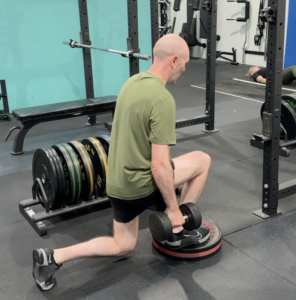
- Single-leg work. Step-ups, split squats and single-leg deadlifts all demand the stability that everyday balance relies on.
- Controlled instability. Small, deliberate challenges to your base of support, progressed gradually and always with a coach watching.
- General strength through the legs, hips and core. Balance depends on strength as much as coordination. A stronger base gives you more margin for error when something unexpected happens.
- Reaction and control work. Practising how you catch yourself, not just how you stand still.
None of this needs to be daunting. It’s just part of a properly built program, scaled to where you’re starting from and built up as your confidence grows.
Why this matters more as the decades add up
This matters at any age, but it matters more over time. A fall in your 30s is usually an inconvenience. A fall in your 60s or 70s can change your independence for good, affecting everything from living arrangements to how confidently you move through the world.
The earlier you build the strength and control to prevent a fall, the better. It’s far easier to maintain balance you already have than to rebuild it after a scare, or after months of reduced activity following an injury.
Start before you need to
You don’t need to wait for a stumble to take balance seriously.
If you’re over 40, based in or around Ringwood, and you’d like a proper look at your strength and balance, get in touch with our team for a no-pressure chat about where you’re at.
— Max